Want to Know More?
If you do, we have some things for you.
Some stories carry differently in moving image than in print — voice, place, music, the texture of country and faces. Our curated video selection ↓ draws from NITV, ABC iview, SBS On Demand, and other sources, for visitors who want to encounter this material through screen as well as page.
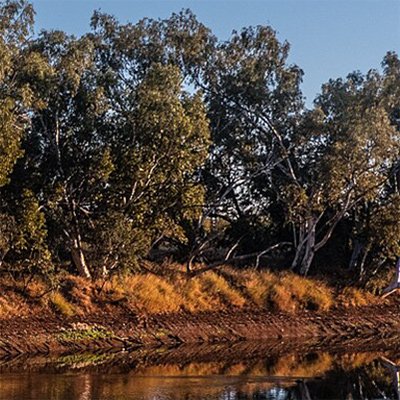 If you want to understand the Country you’re on
Every place in Australia is the Country of a First Nation.
If you want to understand the Country you’re on
Every place in Australia is the Country of a First Nation.
Every place in Australia is the Country of a First Nation. Knowing whose Country you stand on is the beginning of any honest engagement.
-
AIATSIS Map of Indigenous Australia
The canonical map of First Nations language, social, and nation groups across the continent. Produced by the Australian Institute of Aboriginal and Torres Strait Islander Studies, it shows the general locations of hundreds of groups — a reminder that there is no singular "Indigenous Australia" but many distinct peoples, each with their own Country and laws.
A map, not a territory. The creators note it is a guide only, drawn from published sources up to 1994, not intended for native title or land claims.
-
Common Ground
A First Nations-led not-for-profit centring First Nations storytelling, truth-telling, and cultural education. Their site carries clear, accessible writing on everything from understanding Country to doing allyship well — all produced by or with First Nations voices.
-
The Uluru Statement from the Heart
In 2017, over 250 First Nations delegates gathered at Uluru and issued a statement to the Australian people calling for Voice, Treaty, and Truth. It is the clearest articulation by First Nations leaders of what substantive recognition could look like. The 2023 referendum on the Voice failed, but the statement itself remains — an invitation still open.
"Sovereignty is a spiritual notion: the ancestral tie between the land and the peoples born therefrom. It has never been ceded."
-
Welcome to Country — by Marcia Langton
A travel guide to Indigenous Australia by Professor Marcia Langton AO, a Yiman and Bidjara woman. The book maps Indigenous heritage sites, cultural tours, national parks, and places to engage with First Nations cultures across the continent — written by one of Australia's most prominent First Nations scholars. A practical companion for anyone wanting to move beyond reading into visiting, learning, and listening on Country.
Hardie Grant Travel, 2018. Regularly updated editions.
 If you want the history you weren’t taught
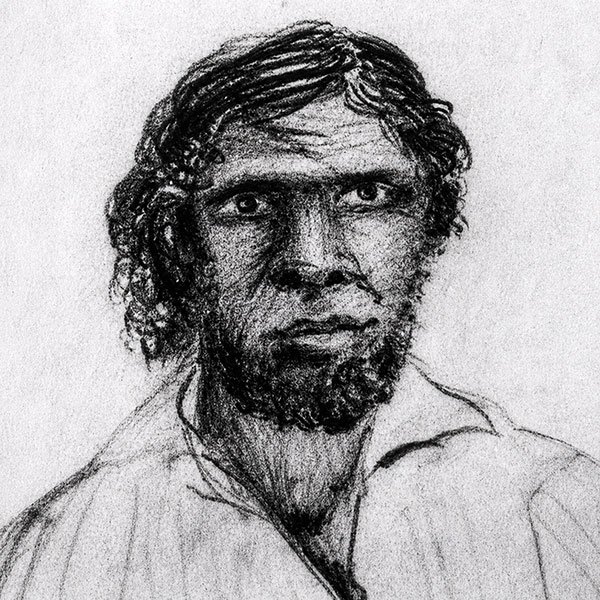
Brisbane and its surrounding Country were not quietly settled.
If you want the history you weren’t taught
Brisbane and its surrounding Country were not quietly settled.
Begin with First Nations historians who have done the foundational scholarship on their own peoples’ histories. Then, for further context, work by non-Indigenous historians who have written with integrity on the frontier wars and colonial Brisbane.
First Nations historians
-
Professor Marcia Langton AO
A Yiman and Bidjara woman, one of Australia’s most prominent First Nations scholars. Foundation Chair of Australian Indigenous Studies at the University of Melbourne since 2000, Melbourne Laureate Professor, and a sustained public voice on land rights, treaty, native title, and the recognition of First Nations sovereignty over more than four decades. Her body of work spans academic scholarship, public commentary, and accessible writing for general readers.
Key works include First Australians (with Rachel Perkins, Miegunyah Press, 2008) — companion volume to the landmark SBS documentary series — and Welcome to Country (Hardie Grant, 2018).
-
Sister Girl — by Jackie Huggins
Dr Jackie Huggins AM FAHA is a Bidjara and Birri Gubba Juru woman from Queensland, one of the most respected Aboriginal historians and activists in the country. She co-chaired the Queensland Government's Treaty Working Group and in 2025 was appointed inaugural Elder-in-Residence at the ABC. Sister Girl collects her essays on Aboriginal women, identity, reconciliation, and the Stolen Generations — she served as Queensland Co-Commissioner for the national inquiry that produced the Bringing Them Home report.
University of Queensland Press. Originally 1998; revised and expanded edition 2022. See also her biography of her mother, Auntie Rita (Aboriginal Studies Press, 1994).
-
The Koori History Website — by Gary Foley
Professor Gary Foley is a Gumbainggir man, activist, and historian. In 1994 he created the Koori History Website — a free, extensive online archive of Aboriginal political history, including the Aboriginal Tent Embassy, the Black Power movement, Aboriginal legal and medical services, and the long arc of First Nations activism from the 1960s onward. A First Nations historian's own archive, accessible to anyone with an internet connection. Foley is currently Professor at Victoria University's Moondani Balluk Indigenous Academic Unit.
Stories First Nations communities are recovering
-
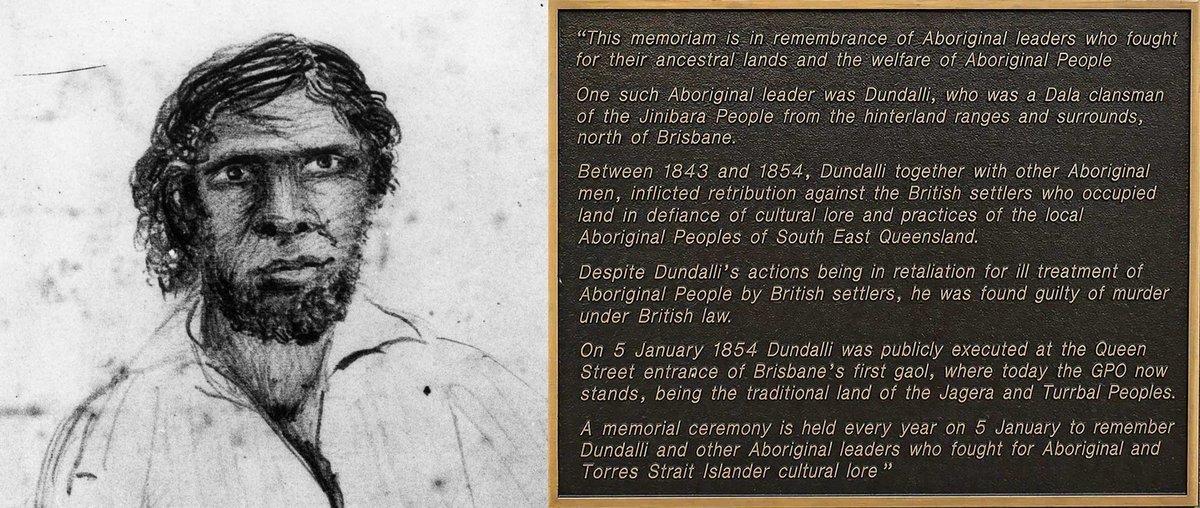
Sketch of Dundalli by Silvester Diggles, 5 December 1854 (State Library of Queensland), beside the small plaque at Post Office Square that currently acknowledges him. Dundalli, warrior and lawman
A Dalla man from the Blackall Ranges north of Brisbane, Dundalli (c.1820–1855) was a Turrwan — a “great man” or leader — chosen to unite clans in resistance against the shootings and poisonings of Aboriginal people by settlers in colonial Brisbane. For over a decade he led a sustained campaign of restorative justice under Aboriginal law. He was publicly hanged at what is now Brisbane’s GPO on 5 January 1855 — the last official public execution in Queensland. A small plaque at Post Office Square acknowledges him today. Uncle Bill’s work includes a current project to see Dundalli more fully recognised as the leader he was. Brisbane’s history would be more honest if it recognised him as a leader who fought to protect his people and his lands.
The definitive biography is Warrior: A Legendary Leader’s Dramatic Life and Violent Death on the Colonial Frontier by Libby Connors (non-Indigenous historian, University of Southern Queensland; Allen & Unwin, 2015). Winner of the Queensland Premier’s Award and the Magarey Medal for Biography.
Further context — non-Indigenous historians
-
Aboriginal Campsites of Greater Brisbane — by Ray Kerkhove
Non-Indigenous historian. Dr Ray Kerkhove has worked for more than thirty years with Aboriginal families and organisations in southern Queensland. This book documents where Aboriginal camps flourished across Brisbane — from convict times through to as late as the 1950s. Many suburbs trace their names, parks, and key events to these camps. A useful corrective to any belief that Brisbane was ever empty of Aboriginal presence.
Boolarong Press, 2015. See also Kerkhove’s work on frontier conflict mapping, smoke-signal communications, and the Battle of One Tree Hill.
-
Forgotten War — by Henry Reynolds
Non-Indigenous historian. A systematic account of the frontier wars fought across Australia between the 1790s and the 1920s. Conservative estimates suggest around 30,000 people died on the Australian frontier, some ninety per cent of them Indigenous. Reynolds argues that Australia cannot be reconciled with its own history until these wars are officially recognised alongside the overseas conflicts commemorated in every town square.
NewSouth Publishing, originally 2013; revised edition 2021. Winner of the Victorian Premier’s Award for non-fiction.
-
First Australians — SBS documentary series
A landmark seven-part documentary chronicling the history of Aboriginal people across the continent from 1788 to the present, produced by Blackfella Films and presented by Rachel Perkins (Arrernte/Kalkadoon). Combining archival material, dramatic recreation, and contemporary interviews, the series tells the story of dispossession, resistance, and survival from First Nations perspectives. The companion book by Perkins and Marcia Langton offers extended scholarly material.
Directed by Rachel Perkins. SBS, 2008. Available on SBS On Demand and NITV.
-
The Dark Emu Story — documentary film
Blackfella Films production exploring a First Nations author’s work and the debate it provoked. Bruce Pascoe’s 2014 book Dark Emu claimed that First Nations peoples practised agriculture, aquaculture, and complex economies before colonisation. The documentary engages both sides of the scholarly debate with commentary from Stan Grant, Marcia Langton, Bill Gammage, Narelda Jacobs, and others. Winner of the 2024 NSW Premier’s Digital History Prize.
Directed by Allan Clarke. Released 2023. Available on ABC iview and DVD.
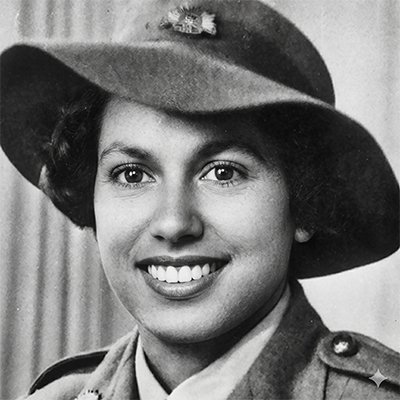 First Nations voices — books, films, storytelling
A few doors — each opening onto a different country of experience.
First Nations voices — books, films, storytelling
A few doors — each opening onto a different country of experience.
Work created by First Nations authors, filmmakers, and storytellers. These are not a canon. They are a few doors — each opening onto a different country of experience.
-
Carpentaria — by Alexis Wright
Miles Franklin Award winner, 2007. An epic novel set in the Gulf Country of north-west Queensland — the country of the River people, near Uncle Bill's own Country. Wright is a Waanyi woman. The book is sprawling, darkly funny, fiercely political, and rewards patient reading.
-
Growing Up Aboriginal in Australia — edited by Anita Heiss
An anthology of over fifty Aboriginal writers sharing what it was like to grow up Aboriginal in Australia. The range of voices — young and old, rural and urban, well-known and not — resists any single narrative. If you read only one book from this list, this is the one that says most clearly: there is no single story.
-
The White Girl — by Tony Birch
Shortlisted for the Miles Franklin Award, 2020. Birch writes a novel of the 1960s that holds the weight of the Stolen Generations without flinching and without sensationalising. A grandmother and granddaughter on the run. Quietly devastating.
-
Always Was, Always Will Be — by Thomas Mayo
A short, clear, accessible book on the Uluru Statement from the Heart by one of its prominent Yes campaign leaders — a Kaurareg Aboriginal and Kalkalgal, Erubamle Torres Strait Islander man. Useful for anyone wanting to understand what was asked for, what happened, and what remains.
-
Rabbit-Proof Fence — film
The story of the Stolen Generations told through three girls’ escape home to their mothers across the continent in 1931, based on the book by Doris Pilkington Garimara (Mardudhunera) about her own mother. The film’s release in 2002 brought the Stolen Generations to international audiences.
Directed by Phillip Noyce. 2002. Available on streaming platforms.
-
Samson & Delilah — film
A Cannes Camera d’Or-winning love story set in Central Australia, by Kaytetye filmmaker Warwick Thornton. Spare, lyrical, and devastating — following two Aboriginal teenagers from a remote community to Alice Springs and back. Largely without dialogue. A landmark of Australian cinema.
Directed by Warwick Thornton. 2009. Available on SBS On Demand and streaming platforms.
-
Sweet Country — film
Warwick Thornton’s 2017 frontier-era drama set in the Northern Territory in 1929. Based on real events, it follows an Aboriginal stockman who shoots a violent white station owner in self-defence and goes on the run. A historical Western told from First Nations perspective. Won prizes at Venice and Toronto film festivals.
Directed by Warwick Thornton. 2017. Available on streaming platforms.
-
In My Blood It Runs — documentary
Maya Newell’s 2019 documentary follows Dujuan, a 10-year-old Arrernte/Garrwa boy in Alice Springs, navigating Australian schooling that does not see him. Made in close collaboration with Dujuan, his family, and the community. Used in Dujuan’s 2019 address to the United Nations Human Rights Council.
Directed by Maya Newell with the family of Dujuan Hoosan. 2019. Available on ABC iview and streaming platforms.
-
The Final Quarter — documentary
Ian Darling’s 2019 documentary about the racist treatment of Adam Goodes during his final three years as an AFL player — told entirely through existing media footage, without new interviews. Damning. Watching it is what understanding what Adam Goodes endured looks like.
Directed by Ian Darling. 2019. Available on ABC iview.
-
More to find
The film and television sections of the Common Ground and NITV websites carry regularly-updated lists of First Nations cinema worth watching, including new releases.
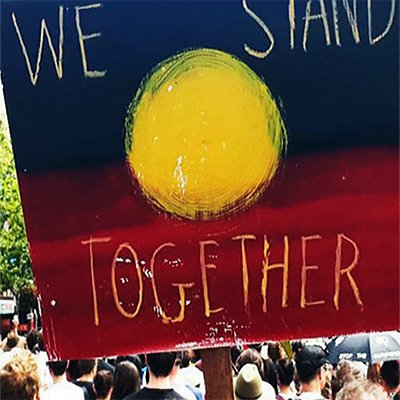 If you want to do Allyship better
A practice, not a position — active, ongoing, grounded in listening.
If you want to do Allyship better
A practice, not a position — active, ongoing, grounded in listening.
Allyship is a practice, not a position — active, ongoing, grounded in listening. Having read and heard First Nations voices, these organisations offer concrete paths for moving from understanding into action.
-
Common Ground: Meaningful Allyship 365 Days a Year
A direct, practical guide to what allyship actually requires — written by a First Nations organisation. Deep listening, building relationships grounded in truth and accountability, understanding that self-determination is at the heart of the work. A good place to start, and to return to.
-
The Healing Foundation
The national Aboriginal and Torres Strait Islander organisation supporting Stolen Generations survivors and their families. Their work addresses the intergenerational trauma of the forced removal of children — trauma that shapes Australia still. The 1997 Bringing Them Home report remains foundational, and decades on, its recommendations are still unfinished business.
-
Reconciliation Australia
The national body for reconciliation work, convening Reconciliation Week annually and supporting Reconciliation Action Plans (RAPs) across organisations. Their resources include practical guidance for workplaces, schools, and individuals wanting to take tangible action.
-
First Nations Allies — Magandjin (Brisbane)
The Brisbane-based allies network where Uncle Bill serves as Co-Chair. A local organisation for people in South-East Queensland ready to move from awareness to active participation in First Nations advocacy, truth-telling, and community support.
Official public link and full description to be added.
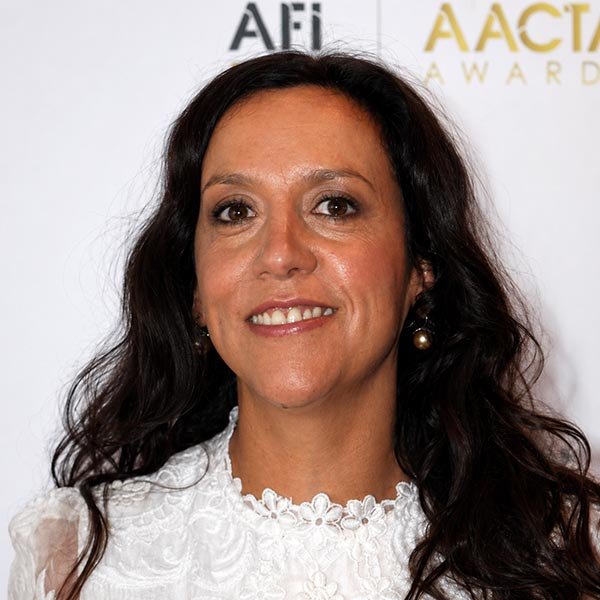 If you want to watch
A curated selection of First Nations cinema and documentary.
If you want to watch
A curated selection of First Nations cinema and documentary.
Films and documentaries by First Nations creators and about First Nations subjects, chosen with the same care as the books on this page. Each title appears here in addition to (not instead of) its contextual place in the sections above. Where we know an official trailer exists, we link to it — and to the platform where the work can be watched.
-
First Australians — SBS documentary series (2008)
Rachel Perkins’ landmark seven-part chronicle of Aboriginal history from 1788 to the present. Begins anywhere; rewards watching in sequence.
-
The Dark Emu Story — documentary (2023)
Allan Clarke’s feature exploring Bruce Pascoe’s book and the scholarly debate around it. Multiple voices, both First Nations and non-Indigenous, engaging seriously with the questions Pascoe raised.
-
Rabbit-Proof Fence — film (2002)
Phillip Noyce’s adaptation of Doris Pilkington Garimara’s book about three Stolen Generations girls walking home along the rabbit-proof fence in 1931. Brought the Stolen Generations to international audiences.
-
Samson & Delilah — film (2009)
Warwick Thornton’s Cannes Camera d’Or-winning love story set in Central Australia. Largely without dialogue. Devastating and luminous in equal measure.
-
Sweet Country — film (2017)
Warwick Thornton’s frontier-era drama set in the Northern Territory in 1929. A historical Western told from First Nations perspective. Won prizes at Venice and Toronto film festivals.
-
In My Blood It Runs — documentary (2019)
Maya Newell’s documentary made with Dujuan, a 10-year-old Arrernte/Garrwa boy in Alice Springs. Used in Dujuan’s 2019 address to the United Nations Human Rights Council.
-
The Final Quarter — documentary (2019)
Ian Darling’s documentary about the racist treatment of Adam Goodes during his final three AFL years — told entirely through media footage. Damning.
-
More to find
The film and television sections of Common Ground and NITV carry regularly-updated lists of First Nations cinema worth watching, including new releases as they arrive.

— Uncle Bill