
“Growing up in Cherbourg” means something no other Queensland town means. For most of the twentieth century it meant growing up inside a system run by white officials who decided where you lived, who you married, what they paid you, and whether you could leave.
It also meant growing up among people who refused to let that system decide who they were. Both are true, in the same place, at the same time. Both belong in any honest account of Cherbourg.
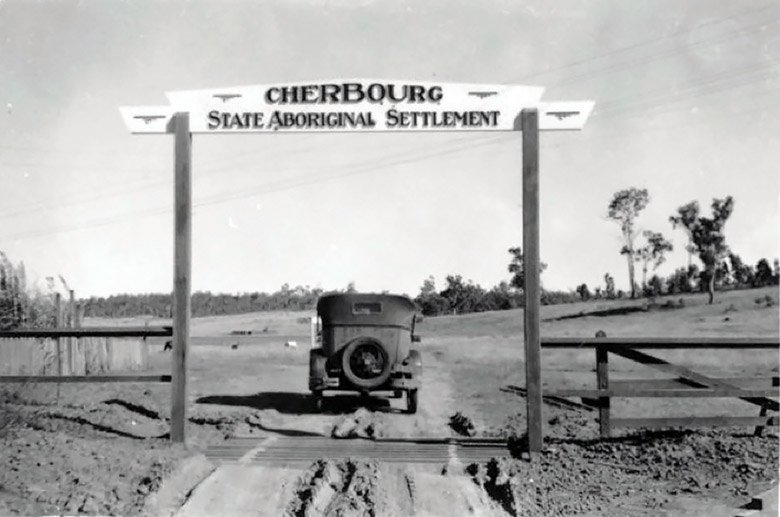 The entrance to the settlement The name arrived from England by way of a pastoral run, and then stood over the road as an official fact. State Library of Queensland.
Before it was Cherbourg, this was Wakka Wakka Country, and the land had a Wakka Wakka name. Early accounts record the district as “Burrumbeer,” meaning roughly “the wind is coming.” The settlement’s first English name, Barambah, is thought to be a corruption of that word (Hilary Bambrick, Child growth and Type 2 Diabetes Mellitus in a Queensland Aboriginal Community, chapter 4).
So the name that came before Cherbourg was already a settler mishearing of an Aboriginal word.
William Thompson of the Salvation Army began negotiating with the Queensland Government in 1899 for land on which to establish an Aboriginal mission. After a first site proved unsuitable, the Queensland Government gazetted the Barambah Aboriginal Settlement over 7,000 acres on 23 February 1901 (Find & Connect; Queensland Government community history). The settlement held that name for three decades.
In 1932 the government renamed it Cherbourg for a plainly practical reason: mail kept going astray to the neighbouring Barambah pastoral station (Thom Blake, A Dumping Ground; Find & Connect).
The new name came from one of the ten blocks that made up that pastoral run (Queensland Places, University of Queensland), itself believed to be a corruption of Chirbury, a town in Shropshire, England, birthplace of the pastoralist who first leased the run (Wikipedia).
Cherbourg’s name reached Queensland from England, by way of a pastoral run: an English place name, borrowed for postal convenience, laid over a Wakka Wakka word that settlers had already reshaped into something else. The French port city had nothing to do with it.
This was never a name the community chose for itself. Almost everything that follows flows from that one fact: a place, and the people in it, named, moved and managed by others.
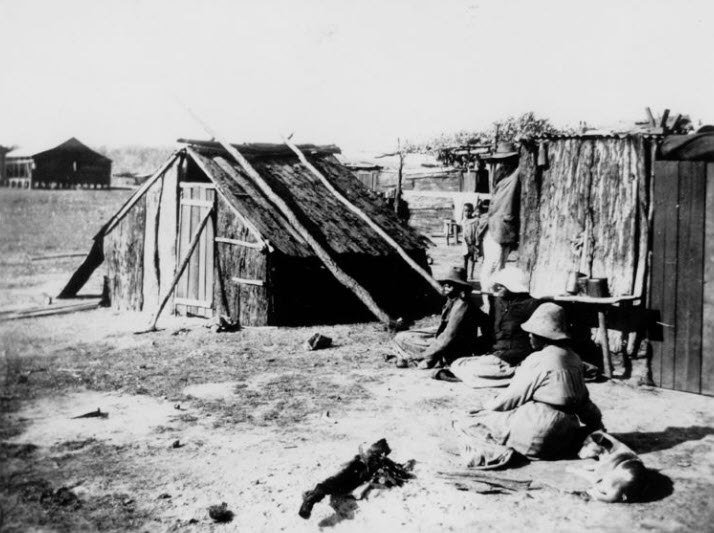 Shelters at Barambah Aboriginal Settlement, around 1920 Housing at Barambah was built by the people sent there, from bark, salvaged iron and whatever else came to hand. State Library of Queensland.
Thompson’s mission was small and struggling. When the first large group of new arrivals reached Barambah in May 1901 (forty people brought from Durundur, joined along the way by thirty-three more from Kilkivan), they found Thompson’s own family living in a tent, stores kept in a grass-roofed slab hut, and no shelter prepared for them.
People slept in the open until they could build crude huts. One woman who had left Durundur in apparent good health died soon after arriving (Thom Blake, A Dumping Ground).
The mission survived on a government grant of £300 a year for seventy residents in 1901, cut to £250 in 1904 though the population had nearly doubled.
Thompson’s superintendency ended abruptly in September 1904, when a horse-riding accident put him in hospital for nine months. The mission’s Ipswich sponsors readily agreed to hand over control, and in March 1905 the Queensland Government took charge of Barambah, appointing Albert Tronson as superintendent.
Between 1905 and 1910 the settlement’s revenue rose fourfold, from £271 to £1,311, and the government read those numbers as proof that a directly managed reserve could pay its own way (Thom Blake, A Dumping Ground). In time the government held Cherbourg up as the model Aboriginal settlement, and read its apparent success as vindication of the reserve system itself.
From here, Barambah grew the way most Queensland reserves grew: by government order.
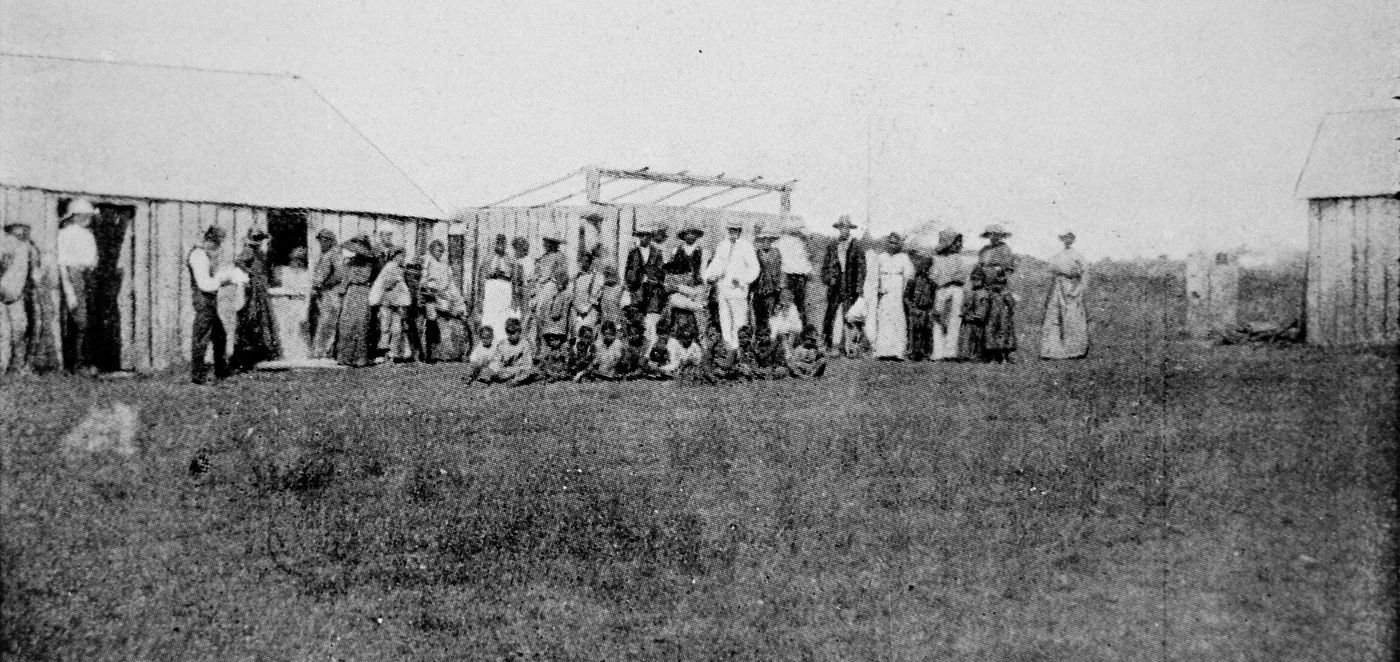 Large group at Barambah Aboriginal Settlement, 1907 Two years after the government took control. Almost none of these people came here by choice. State Library of Queensland.
Between 1905 and 1939, under its own protection laws, the Queensland Government forcibly removed 1,587 Aboriginal people to Barambah and Cherbourg, an average of forty-five a year (Thom Blake, A Dumping Ground). The pattern was volatile: six people in 1906, then 158 in 1916, the peak year, when drought pushed removals across the state to unprecedented levels.
In 1913, JW Bleakley, who would run Queensland’s protection system for nearly three decades as Chief Protector, described the place as “a dumping ground for the lame, the halt and the incorrigible … the black criminals of the state” (quoted in Thom Blake, A Dumping Ground). Blake’s history takes its title from that phrase.
People were sent for reasons that had little to do with their own welfare: for being judged too old, for drinking, for stirring up trouble, for an accusation never tested in court.
The families counted at the settlement by anthropologist Caroline Tennant-Kelly in 1934 belonged to twenty-eight distinct tribal groups, and even that understated the mix: her count left out everyone from north of a line between Bowen and Cloncurry. By the late 1930s Blake puts the figure at no fewer than thirty-six tribal groups among roughly 900 residents (Thom Blake, A Dumping Ground).
Few of these families chose to be neighbours. An administrator’s decision made them so.
Removal met resistance that Blake describes as “spirited and sustained.” Families fled into the bush when police arrived with removal orders, and people kept deserting the settlement itself. In July and August 1905 alone, Superintendent Tronson recorded twelve desertions.
In 1929, eight people fled roughly 200 kilometres to Chinchilla; when caught, police returned all but one, and the administration deported Leslie Jerome, judged the instigator, to Palm Island as punishment. Tommy Tommyhawk, removed to Barambah twice after being wrongly suspected of a murder, escaped both times and walked back to his family in the Cairns district, more than 1,900 kilometres away.
Chief Protector Bleakley called such journeys “remarkable feats of endurance” (Thom Blake, A Dumping Ground). People kept walking home, again and again, even when home lay more than a thousand kilometres and a police escort away.
People removed
1,587
Aboriginal people forcibly removed to Barambah/Cherbourg between 1905 and 1939.
Peak year
158
Removals in 1916 alone, at the height of drought across Queensland.
Tribal groups
28
Recorded at the settlement by Caroline Tennant-Kelly in 1934; at least 36 by the late 1930s.
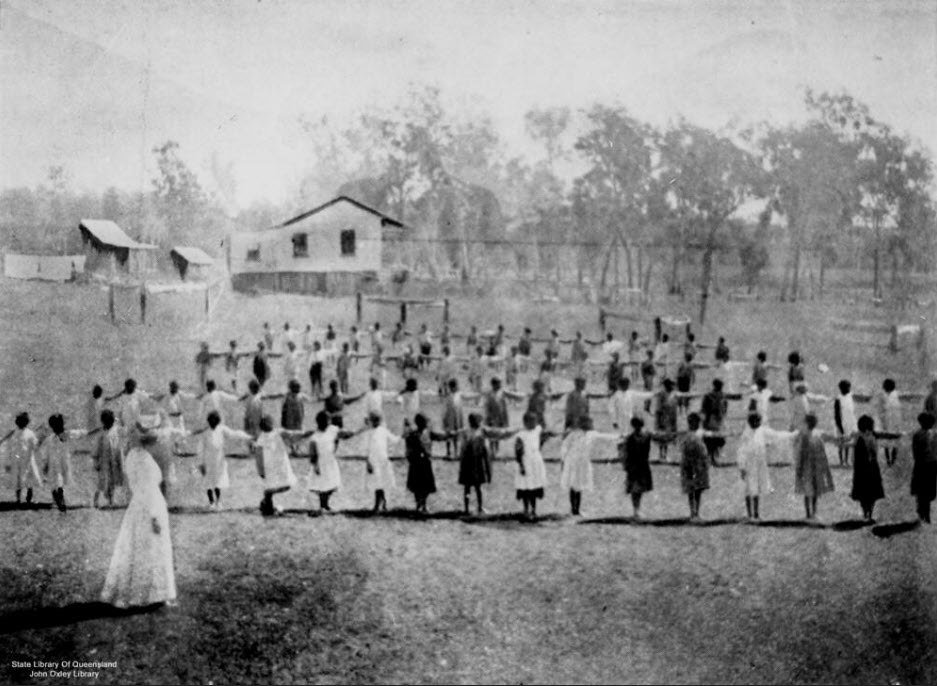 Drill outside the school, Barambah Children spaced by arm’s length, in rows, under supervision. The daily order of the settlement reached the children first. State Library of Queensland.
The dormitory system sits at the centre of Cherbourg’s history. A girls’ dormitory went up in 1909 and a boys’ dormitory the following year. Both were bare sleeping quarters, with children on the floor because the administration supplied neither beds nor mattresses.
A larger girls’ home, the Stopford Home, opened on 2 October 1925, followed by a mothers’ and babies’ dormitory in 1927 and a new boys’ dormitory in 1928 (Thom Blake, A Dumping Ground).
The share of the settlement living this way kept rising: 3 per cent of the population in 1910, over 22 per cent by 1933. By the early 1930s two out of three children aged between five and fourteen were dormitory inmates, separated from parents who, in many cases, lived in the camp nearby (Thom Blake, A Dumping Ground; Find & Connect).
Ruth Hegarty grew up in the Cherbourg girls’ dormitory from the age of four, after she and her mother, Ruby, were separated, and later told her own story in the memoir Is That You, Ruthie?
Her description of dormitory life is exact: “Our lives were governed by the same policies, and what happened to one, happened to all of us. We were treated identically, dressed identically, our hair cut identically. We were dormitory girls” (Ruth Hegarty, Is That You, Ruthie?).
The rules reached even to hair. Dormitory girls’ heads were shaved at every head-lice inspection: “I can always remember the clippers were cold. There would be tears when you saw all your hair being cut. You were never allowed even a cap on your head. You could always tell the dormitory kids, they had bald heads, while the camp kids would have nice hair” (quoted in Thom Blake, A Dumping Ground).
Inside that regime, the girls made something of their own: each other. Of her dormitory sisters Nellie O’Chin and Viola Hill, Hegarty said: “It drew us together. We became sisters. We are all sisters, always have been. We looked about for one another … We had a bond” (quoted in Thom Blake, A Dumping Ground).
The dormitory girls even developed “dormitory talk,” a coded language of their own that the supervising staff could not follow. “It was marvellous,” Hegarty said of it. “It was something we had; nobody could take that away from us.”
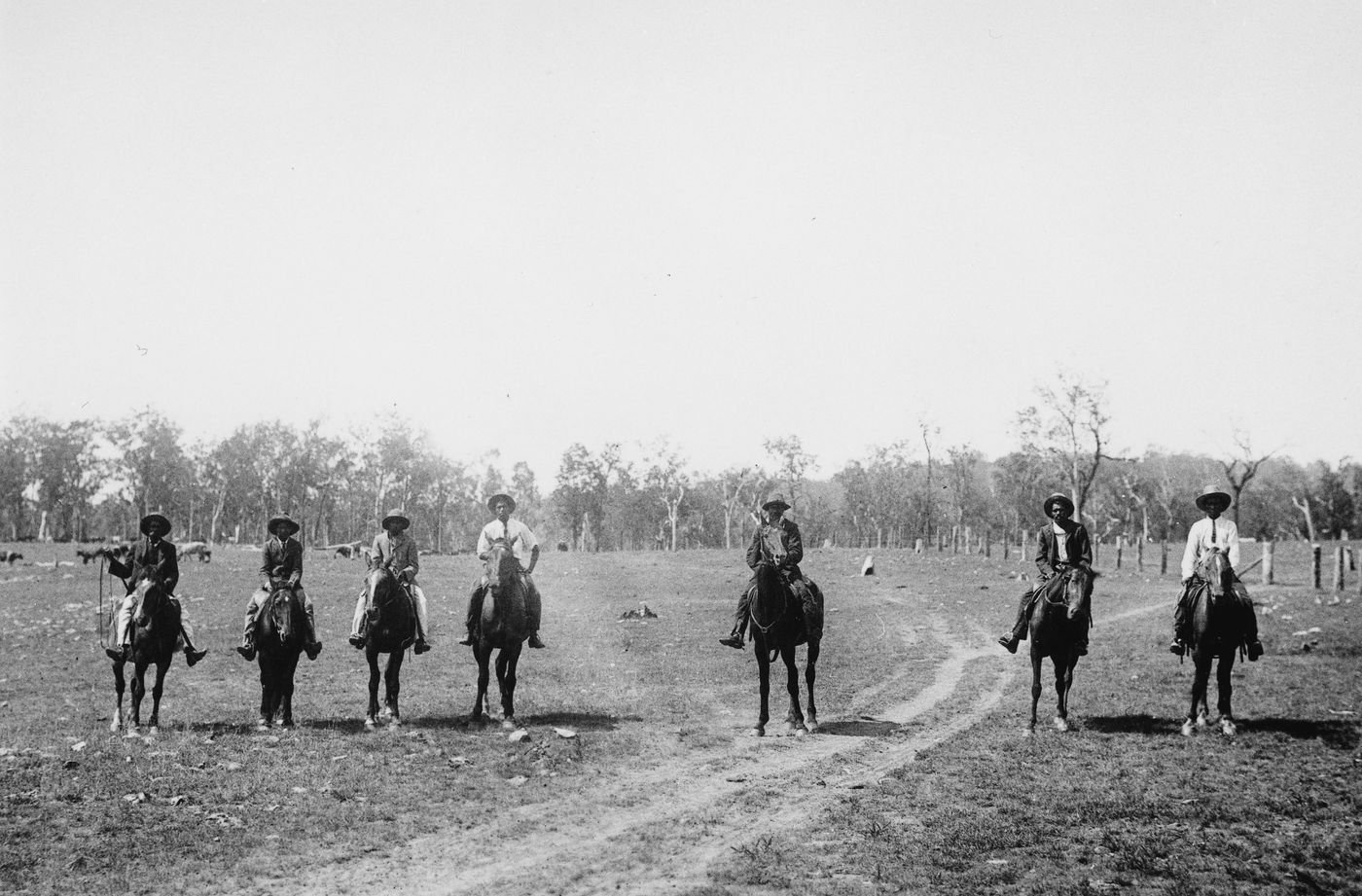 Stockmen at Barambah Aboriginal Settlement, 1911 Skilled work, done under the Act. The wages went to the administration, not to the men on the horses. State Library of Queensland.
Cherbourg also served the region as a labour pool. The settlement sent Aboriginal men out for fencing, shearing, dairying and land clearing, and hired Aboriginal women out as domestic servants. Under the protection system, wages went to government administrators rather than to the workers who earned them, with a compulsory levy deducted on top.
John Cobbo, a Cherbourg man who had served two and a half years in the AIF, put the arrangement plainly in a 1937 letter asking to be freed from the Act: “I have to give half my wages to the settlement … All I ask is the liberty to go to work and keep the money I earn.” The superintendent rejected his application, having decided he was “not a good type of native” (Thom Blake, A Dumping Ground).
The arrangement drew fire inside Parliament as well. In 1934, James Kenny, the member for Cook, told the House: “Not only does the Government control the capital of the native; they also confiscate his interest” (Thom Blake, A Dumping Ground).
Lesley Williams, who grew up at Cherbourg and later wrote the memoir Not Just Black and White with her daughter Tammy, spent years fighting to retrieve the wages and savings withheld from her as a young domestic worker under the Protection Acts. She signed a deed of settlement in August 1999 (Right Now).
In the book’s preface she describes how that fight began: “When I first got the big idea in 1993 to ‘write a book’ about my life and the missing wages and savings, I found it difficult to even string two sentences together … I’d always clam up whenever it came time to put pen to paper. Therefore, in the early days, to tell my story I first had to say it, speaking into a tape recorder” (Lesley Williams, Not Just Black and White).
In 2024, a quarter of a century after her own settlement, Williams told Queensland’s truth-telling inquiry what the wider system had cost: “We were significantly wronged. Not just myself, but my mother, sisters, grandparents, and great-grandparents. This state prospered due to the labour of Aboriginal people” (The Guardian).
Queensland embarks on Path to Treaty with inquiry
The ABC News report on the truth-telling and healing inquiry that heard her evidence. Opens on YouTube.
This is the wider Queensland story of stolen wages: money earned by Aboriginal workers but withheld, deducted, or never accounted for or returned. Many former Cherbourg residents later said that no one ever showed them a record of what they were owed.
In 2019, the Queensland Government agreed to pay $190 million to settle Pearson v State of Queensland, a class action brought on behalf of Aboriginal and Torres Strait Islander workers whose wages had been controlled under these laws: the largest stolen wages settlement in Australian history (SBS News).
The injury ran past poverty. What the system denied, above all, was adult authority over one’s own life.
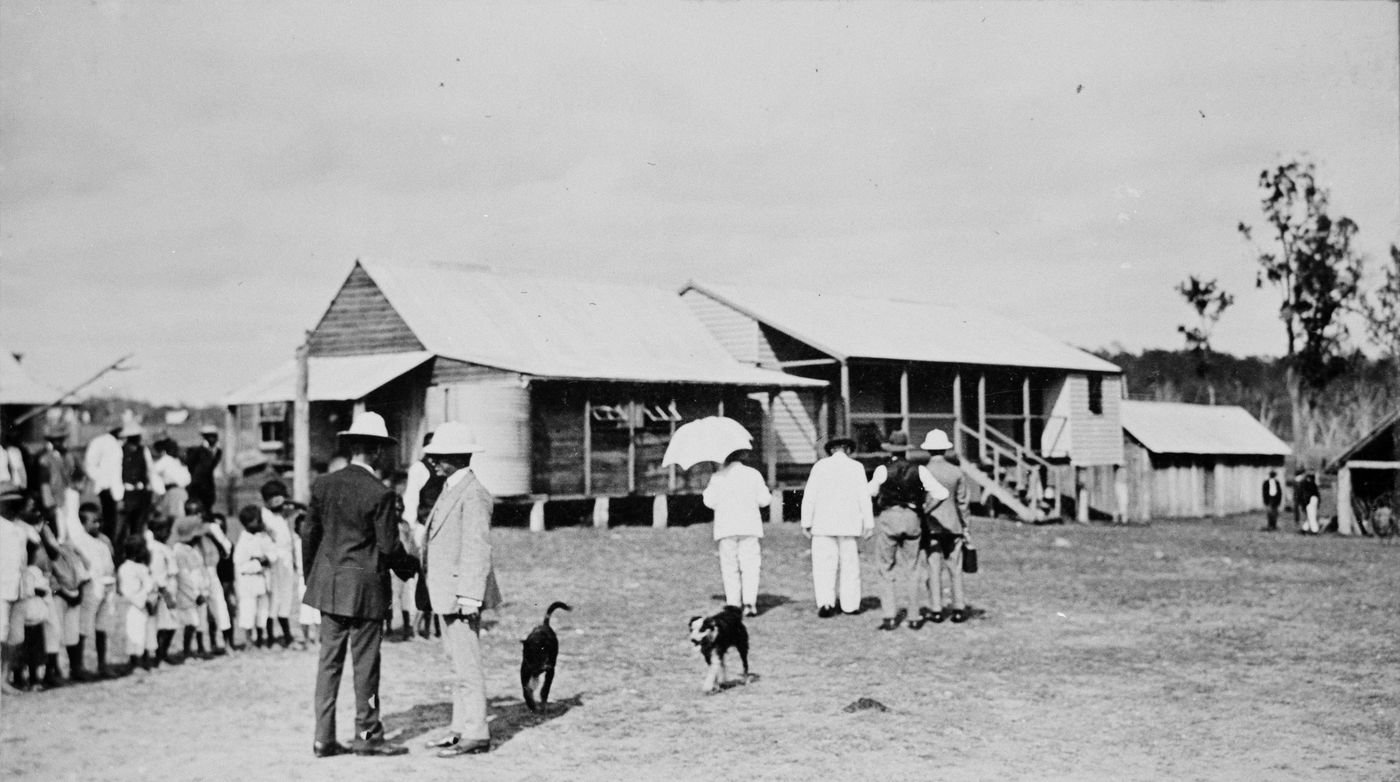 The hospital and the store, Barambah, 1911 The store on the right is where the administration handed out rations. What you received, and when, was decided for you. State Library of Queensland.
The Ration Shed Museum in Cherbourg preserves this history from within the community, and its name points at the everyday reality it describes: food and supplies measured out by an administration that decided who received what, and when. The video above is theirs.
Rations doubled as an instrument of control. To leave the settlement, or to defy it, was to risk going hungry.
That struggle over the most basic control of one’s own life continued long past the ration line. In 1960, Aboriginal pensioners at Cherbourg raised concerns about their treatment and asked to be paid their pensions directly, rather than through the settlement administration. The government refused, offering no further support (Services Australia historical collection).
It is a small, easily overlooked record, and a precise snapshot of what the system demanded of the people under it: ask, politely, for the most ordinary control over your own money, and be told no.
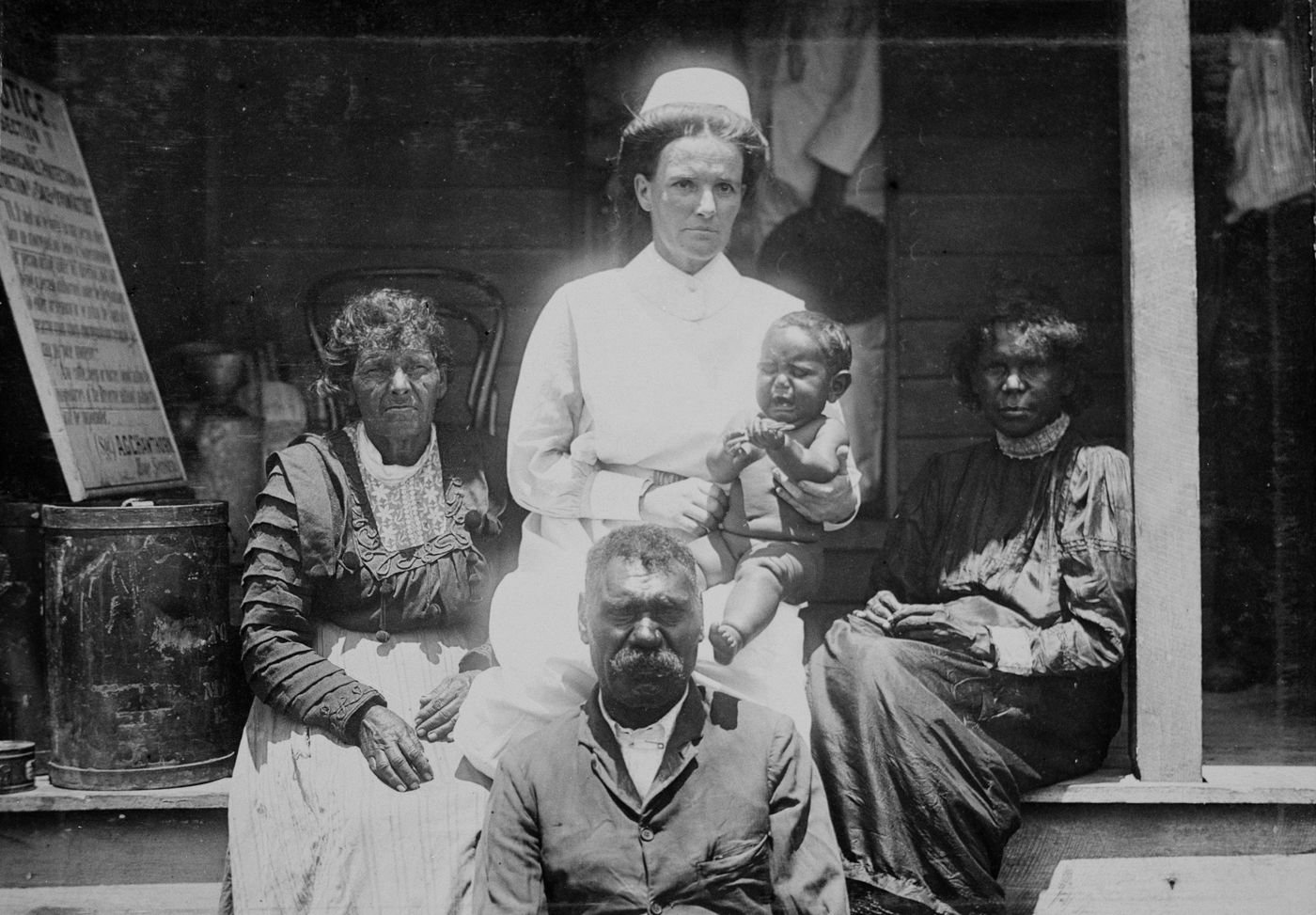 Three generations with the settlement nurse, 1911 Care of a kind was provided. It did not stop one resident in eight dying each year across the first fifteen years. State Library of Queensland.
Government control failed the people it claimed to safeguard. Between 1905 and 1925, the settlement recorded 453 births against 923 deaths. Across the first fifteen years, on average one in eight residents died each year, and one in every three children born did not survive twelve months (Thom Blake, A Dumping Ground).
The chapter of Blake’s history covering health takes its title from a contemporary description of the place: “a depot of semi-starvation, disease and misery.”
The worst came in 1919, when the Spanish influenza pandemic reached the settlement. The first case appeared on 25 May 1919. Three days later, 35 people were dead; after a week, 67; the final toll was 89, close to one in five residents, and only eight people on the settlement escaped infection altogether.
The mortality rate, at 143 per thousand, ran seven times that of the rest of Australia. So many died so quickly that the settlement buried people in mass graves (Thom Blake, A Dumping Ground; ABC News).
Blake’s analysis of the settlement’s health record points at conditions, and behind the conditions, at policy. Overcrowding, poor water and an inadequate diet made infectious disease the settlement’s biggest killer, with eleven major influenza epidemics recorded between 1907 and 1939 (Thom Blake, A Dumping Ground).
The dead of 1919 were casualties of policy as much as of nature.
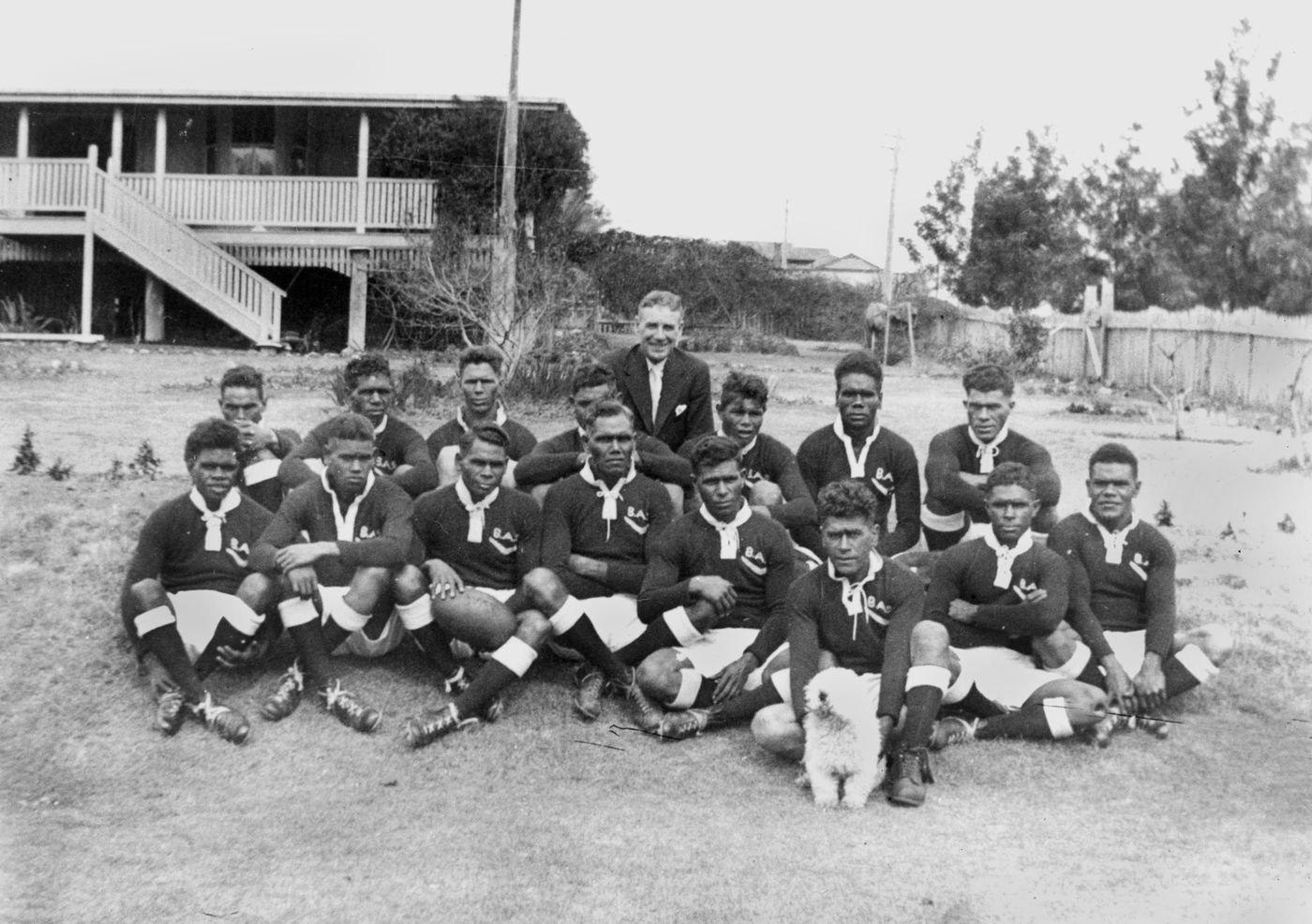 The Barambah rugby league team, 1930s You fought to wear that guernsey, Henry Collins said, and to keep your place in the team. State Library of Queensland.
None of this is the whole story, and a truthful account of Cherbourg cannot reduce the community to what was done to it.
Cherbourg is also a place built, over generations, by the people forced to live there: through kinship, humour, sport, art and an everyday refusal to let the administration decide who they were to one another.
Val Clements, who grew up on the settlement, remembered the depth of that kinship directly: “we knew who every person was. Whether they were Batjala, Kabi Kabi or Wakka Wakka … I knew where they came from” (quoted in Thom Blake, A Dumping Ground).
Officials had thrown dozens of tribal groups together, expecting distinct identities to dissolve into a single controllable population. They produced the opposite. As Kathy Fisher put it: “they didn’t realise that they were creating one big tribe.”
Hope Neill, whose words for what the settlement did to people are among the harshest on record (“treated like slaves … like merchandise”), was just as direct about what grew in spite of it: “Out of oppression evolved an additional kinship, an additional culture, an additional language” (Thom Blake, A Dumping Ground).
People held corroborees on the settlement week after week, one of the few spaces where they could carry cultural life on without fear of recrimination. “The old people just gave things up … But they used to have a lot of corroborees, pretty well every week, and we used to go and see them,” Bowman Johnson recalled (quoted in Thom Blake, A Dumping Ground).
Gambling was a different matter. Successive superintendents tried to stamp out the public penny ring, and lost. By playing in the open, Blake writes, residents declared to the administration: “you do not approve of what we are doing, yet you are powerless to stop us” (Thom Blake, A Dumping Ground).
Sport took that defiance into the wider world. Eddie Gilbert, raised at the settlement, began competitive cricket at fifteen, playing for the nearby farming community of Redgate while sent out to work for a local farmer. Back at Barambah he starred for the settlement side, and from the 1930–31 season for Queensland (Thom Blake, A Dumping Ground).
On 6 November 1931, at the Gabba against New South Wales, he bowled the most famous over of his life. His first ball had the opening batsman caught behind. Of the three balls Don Bradman faced, the first knocked the bat from his hands, the second knocked him off his feet, and the third had him caught behind, out for a duck.
Aboriginal people at Barambah, listening by radio, joined the Brisbane crowd of 7,000 in cheering themselves hoarse (Australian Dictionary of Biography).
Gilbert never played for Australia. Umpires repeatedly no-balled his action for throwing, even though slow-motion film of his arm had found no irregularity (Australian Dictionary of Biography). At Cherbourg the memory is simpler, and possessive: “our Eddie” (Thom Blake, A Dumping Ground).
Football ran on the same pride. Livingstone Chambers, who began playing for the Barambah team in 1928, recalled the advice Frank Fisher gave before every match: “He used to tell us that we weren’t playing for ourselves but playing for Cherbourg” (quoted in Thom Blake, A Dumping Ground).
Henry Collins put the team’s meaning just as plainly: “you fought to wear that Cherbourg guernsey and to keep your place in the team.”
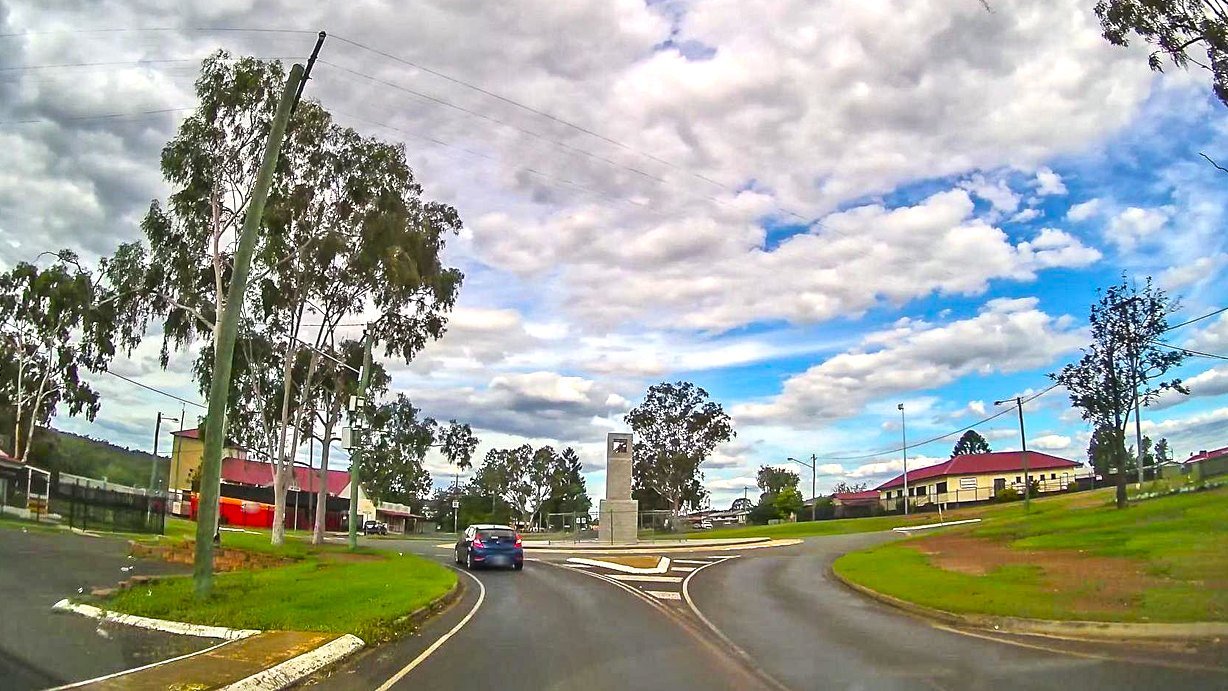 Cherbourg under its own council The town as it stands now: an elected shire council since 1985, and the land itself held by the community since 1986. Photograph by jthnz via Mapillary, CC BY-SA 4.0. Cropped from the original.
Cherbourg people themselves ended government control. Through the 1970s and 1980s the community organised and pushed for the right to govern its own affairs. On 30 March 1985, under the Community Services (Aborigines) Act 1984, Cherbourg residents elected an autonomous community council.
On 28 August 1986, the Queensland Government transferred the land itself to the community under a Deed of Grant in Trust (DOGIT): formal, legal recognition that Cherbourg belongs to its own people (Queensland Government community history).
It came too late for the generations who lived and died under full government control, and it erased nothing of what came before. From this point on, though, the story belongs to what the Cherbourg community has built for itself.
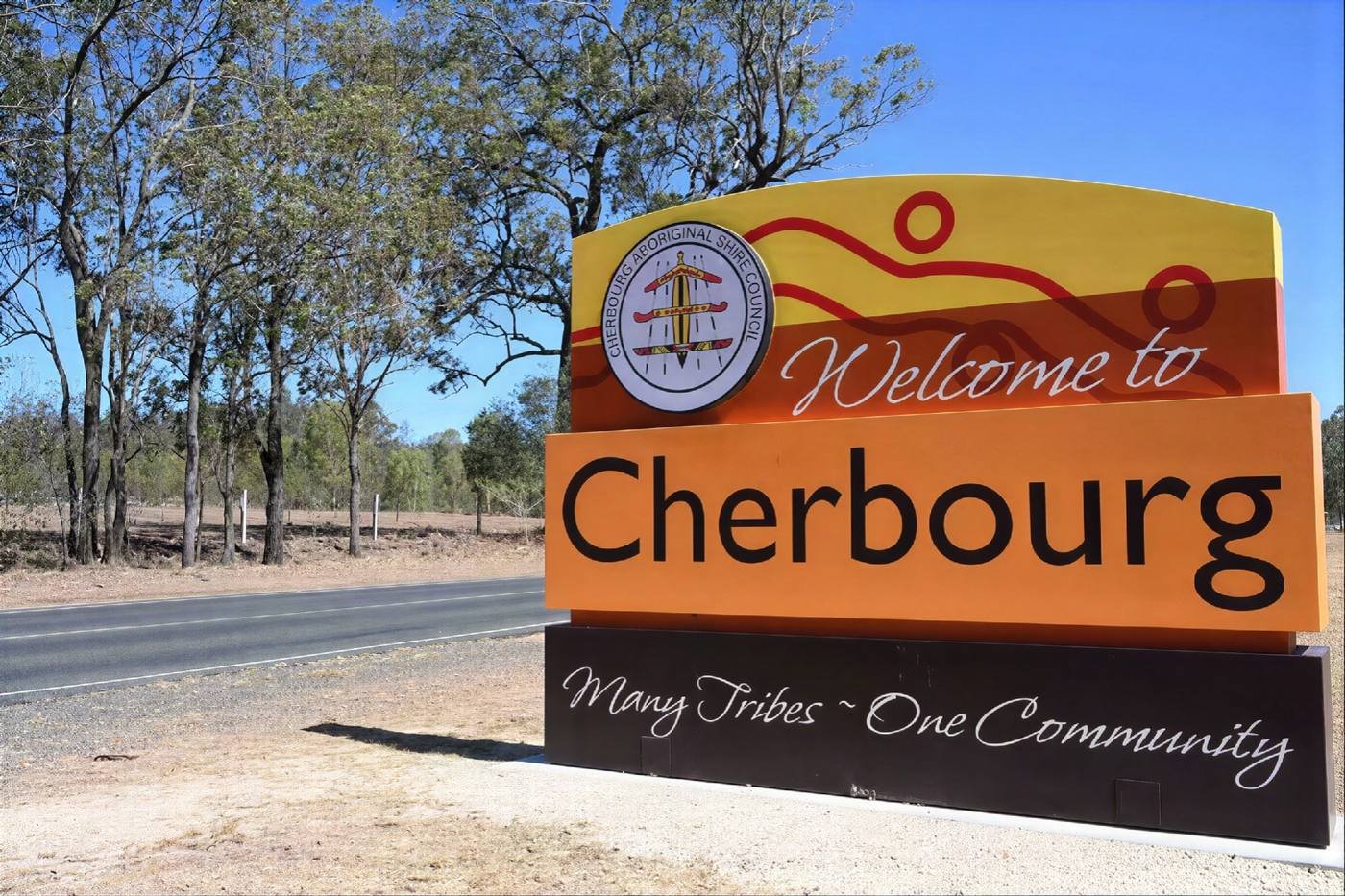 The road in The shire council’s own sign, and its own account of what the settlement became: Many Tribes, One Community. Photograph by Philippe Foubert.
Cherbourg today is home to roughly 1,200 people, 96 per cent of whom are Aboriginal or Torres Strait Islander, one of the highest proportions of any community in Australia (2021 Census).
It runs its own elected shire council, and the Ration Shed Museum, established by the community in 2004 to mark the settlement’s centenary, teaches this history from the inside, on Cherbourg’s own terms.
Cherbourg has also become a nursery of Australian rugby league. Arthur Beetson, the first Indigenous Australian to captain a national sporting team and Queensland’s first State of Origin captain in 1980, was the son of Marie Beetson, a member of the Stolen Generations who left Cherbourg as a young woman and settled in Roma, where Arthur was born (SBS NITV).
Players from Cherbourg have since followed him onto the Origin stage, among them Willie Tonga and Selwyn Cobbo. Cobbo grew up playing junior league for the Cherbourg Hornets, became the first Indigenous school captain in the 75-year history of Murgon State High, and made his Queensland debut on 8 June 2022 (ABC News; The Guardian).
It is a straight line, if you know where to look: from a mother raised under the mission system, to a son captaining Queensland, to a later generation born free in the same town, playing for the same jersey, on their own terms.
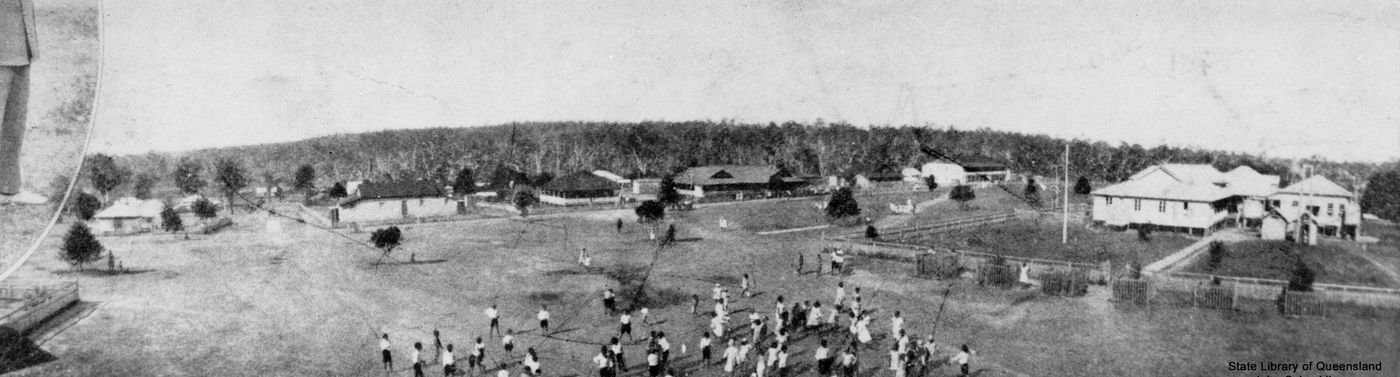 Barambah Aboriginal Settlement, 1931 The year before the name changed. Both truths were already true. State Library of Queensland.
Cherbourg’s history refuses a single lesson. It is the story of a name nobody there chose, a settlement built to isolate and control, a death toll made worse by the government’s own policies, and a system of removals and stolen wages that Queensland is still paying to redress.
It is equally the story of people who kept escaping and walking home, who built “one big tribe” out of enforced strangers, who kept corroborees, kinship and pride alive on a settlement designed to erase them, and whose descendants now run their own council and their own museum, and have captained their own state.
The double truth sits in the two phrases leant on most here. In the words of JW Bleakley, the man who would run Queensland’s protection system for nearly three decades, Barambah in 1913 was “a dumping ground for the lame, the halt and the incorrigible.” In the words of Thom Blake, whose research underpins this account, that same place “also became a place of resistance and survival.”
Both were true then. The second is what visitors to Cherbourg meet today.
Sources and further reading
- Thom Blake, A Dumping Ground: A History of the Cherbourg Aboriginal Settlement – National Library of Australia
- Queensland Government – Cherbourg community history
- Find & Connect – Cherbourg Aboriginal Settlement
- Queensland Places (University of Queensland) – Cherbourg Aboriginal Shire Council
- Hilary Bambrick, Child growth and Type 2 Diabetes Mellitus in a Queensland Aboriginal Community, PhD thesis, Australian National University, 2003, chapter 4, “Landscapes and Legacies: Cherbourg past to present”
- The Ration Shed Museum, Cherbourg
- Ration Shed Museum – Cherbourg Historical Precinct
- Ration Shed Museum – Girls Dormitory Exhibition
- Australian Human Rights Commission – Bringing Them Home, Chapter 5: Queensland
- Services Australia historical collection – “Pensioners raise concerns with Cherbourg settlement”
- Ruth Hegarty, Is That You, Ruthie? – UQP (with introduction by Jackie Huggins)
- ABC Conversations – Aunty Ruth Hegarty
- The Times (Australia) – Leah Purcell’s Is That You, Ruthie?
- Lesley Williams and Tammy Williams, Not Just Black and White – UQP
- Not Just Black and White – official site (preface extract)
- Right Now – one woman’s fight to retrieve her stolen wages
- The Guardian – Queensland truth-telling inquiry hears stolen wages evidence
- AIATSIS – Missions, stations and reserves
- ABC News – the 1919 influenza outbreak at Cherbourg
- SBS News – the $190 million Stolen Wages settlement
- Australian Dictionary of Biography – Eddie Gilbert
- SBS NITV – Arthur Beetson and his legacy in league and in life
- ABC News – Selwyn Cobbo and Cherbourg’s State of Origin legacy
- The Guardian – “Proud is an understatement”: Selwyn Cobbo in Cherbourg
- Wikipedia – Cherbourg, Queensland (name origin, 2021 Census)